

About Us


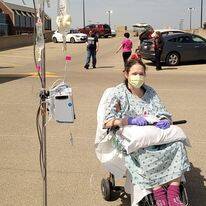
Kirsten Steele arriving at IU Health University Hospital, Indianapolis, Indiana, for her transplant at 11:00 pm, March 28, 2024
Sitting up in her hospital room after moving out of Transplant ICU.
Enjoying the Solar Eclipse in Indy while in the Hospital.
About Keep Kirsten Kicking (K3/K^3)
Kirsten Steele has been fighting intestinal issues her entire life. She was diagnosed with gastroparesis, also known as delayed gastric emptying around 2010. This is a medical disorder consisting of weak muscular contractions (peristalsis) of the stomach, resulting in food and liquid remaining in the stomach for a prolonged period of time.
Kirsten began showing severe symptoms of nausea, vomiting, abdominal pain, loss of appetite, and feeling full after eating just a few bites. This led to her forming complications with malnutrition, fatigue, weight fluctuation, vitamin deficiencies, intestinal obstruction due to bezoars, and small intestine bacterial overgrowth. These could have been caused by damage to the vagus nerve or autonomic neuropathy which she began developing several years earlier. She probably developed some of the risk factors from being diagnosed with diabetes in her twenties, having abdominal and esophageal procedures, and hypothyroidism. Her diagnoses came from a series of test including a Barium swallow X-ray, barium beefsteak meal, radioisotope gastric-emptying scan (GES), esophagogastroduodenoscopy (EGD), and a stable isotope breath test to name a few. Doctors attempted to treat her issues through dietary modifications, medications to stimulate gastric emptying, and medications to reduce nausea and vomiting.
These tests were not helpful in her case and led to several bouts with intestinal obstruction, small intestine bacterial overgrowth, and sepsis. After numerous hospitalizations, she eventually received a modified Multivisceral Transplant (mMVT), which is a surgery that removes diseased or malfunctioning organs along the gastrointestinal tract and replaces them with healthy organs from a single donor. This surgery may involve the small and large intestines, liver, pancreas, or stomach. However, Kirsten did not receive a liver; but she did receive a part of the esophagus, stomach, pancreas, small and large intestine and anal canal.
Fighting Back
We believe - and hope you will also - that everyone deserves the best life possible, and we are working tirelessly to rally everyone in our communities to join our fight to make this possible, especially Kirsten’s. Whether it’s bringing awareness to transplants through increasing information about patient struggles, improving care, or inspiring communities to assist with the fight; we fight on all fronts, because the lessons we learn from one battle can mean victory in another.
Getting Well
You will be assisting in the fight for a better life by providing a guide through every step of the experience. We provide communication to help you better understand Kirsten’s circumstances and other information about the services that you are helping to provide, like transportation to and from treatments, housing while receiving treatment during extended stays far from home, or assistance with other expenses not covered by health insurance. We know we are fighting the good fight – and we’re glad that you are in this fight with us.
Staying Well
You will assist in helping to celebrate every success that she accomplishes by showing your concern. We fight for her to regain the life that she once had and to encourage her to take steps to move forward and provide her with the needed procedures, screening and education to live a healthier lifestyle.
TO DONATE, PLEASE CLICK HERE
TO Contact us, PLEASE CLICK HERE
TO Volunteer, PLEASE CLICK HERE
Create Your Own Website With Webador